


Learning a new language is one of the most rewarding intellectual journeys a person can undertake, but almost everyone who starts asks the same question before they begin: how long does it take to learn a new language? The honest answer is that there is no single number that applies to every learner, every language, and every goal. Someone who wants to order coffee confidently in Spanish during a two-week vacation is working toward a completely different milestone than someone who wants to negotiate business contracts in Mandarin. Yet despite this variability, researchers, linguists, and language institutes have spent decades studying language acquisition patterns, and their findings give us remarkably useful benchmarks. This article breaks down those benchmarks in detail, explores the many factors that speed up or slow down progress, compares different learning methods, and gives you a realistic framework for setting your own timeline.
Understanding What “Learning a Language” Actually Means
Before addressing how long does it take to learn a new language, it is worth pausing on what “learning” even means, because the goalposts shift dramatically depending on the answer. Fluency, proficiency, conversational comfort, and basic survival communication are four very different destinations, and confusing them is the single biggest reason people feel discouraged partway through their studies.
Fluency typically implies the ability to speak, read, write, and understand a language with ease, roughly the way a well-educated native speaker would, though even native speakers vary widely in vocabulary and formal writing skill. Proficiency, especially as measured by frameworks like the Common European Framework of Reference for Languages (CEFR) or the American Council on the Teaching of Foreign Languages (ACTFL) scale, breaks competence into measurable bands, from beginner to advanced. Conversational comfort sits somewhere in the middle, referring to the ability to hold everyday conversations without constant hesitation, even if grammar isn’t perfect and vocabulary is limited to common topics. Survival communication is the most basic tier, covering greetings, directions, ordering food, and handling simple transactions.
When people search for how long does it take to learn a new language, most are actually asking about conversational comfort or working proficiency rather than native-level fluency, because true fluency can take years of immersion even for highly motivated learners. Keeping this distinction in mind will help you interpret every timeline mentioned in this article correctly.
The History Behind Language Learning Timelines
Language acquisition research is not new. Linguists have studied second-language learning since the mid-twentieth century, but the field gained significant structure after the U.S. Foreign Service Institute (FSI) began training diplomats in the 1950s and 1960s. FSI instructors needed a practical way to predict how long does it take to learn a new language for professionals who had to become operationally proficient quickly, often within a single assignment cycle. Over decades of training thousands of diplomats across dozens of languages, FSI compiled data that grouped languages into categories based on how much classroom time English speakers typically needed to reach professional working proficiency.
This categorization system, still referenced today, remains one of the most cited answers to how long does it take to learn a new language, because it is based on real outcomes rather than theoretical estimates. Alongside FSI, the Defense Language Institute and later civilian organizations like the Common European Framework of Reference contributed additional layers of measurement, giving today’s learners access to far more reliable guidance than existed even thirty years ago.
Language Difficulty Categories and Estimated Timeframes
The FSI framework divides languages into four broad categories based on their linguistic distance from English. Category I languages, such as Spanish, French, Italian, Portuguese, and Dutch, are considered the easiest for native English speakers, typically requiring around 600 to 750 classroom hours, or roughly 24 to 30 weeks of full-time study, to reach professional working proficiency.
Category II languages, including German, Indonesian, and Swahili, sit slightly higher in difficulty, generally requiring around 900 classroom hours. Category III languages, a large group that includes Russian, Hindi, Greek, Vietnamese, Thai, and Hebrew, typically require approximately 1,100 hours due to more complex grammar structures, unfamiliar scripts, or tonal elements. Category IV languages, often called the “super-hard” languages for English speakers, include Mandarin Chinese, Cantonese, Japanese, Korean, and Arabic. These typically require 2,200 hours or more, sometimes stretching past 88 weeks of intensive, full-time instruction.
These figures answer how long does it take to learn a new language from an institutional, full-time-study perspective, but most independent learners are not studying eight hours a day in a classroom with native instructors. For someone studying an hour a day, these numbers stretch out considerably, sometimes taking two to four years to reach the same milestone that a diplomat reaches in under a year of immersive government training.
Key Factors That Influence Your Personal Timeline
Understanding averages is useful, but your personal timeline for how long does it take to learn a new language depends heavily on a combination of individual factors, and recognizing them helps you set realistic expectations rather than comparing yourself to someone else’s journey.
Your Native Language and Linguistic Background
The distance between your native language and your target language plays an enormous role. An English speaker learning Italian benefits from shared vocabulary roots, similar sentence structures, and a familiar alphabet, while an English speaker learning Japanese must learn an entirely new writing system, a different grammatical order, and layers of politeness levels that have no direct English equivalent. If you already speak more than one language, you likely have an advantage too, since multilingual learners tend to acquire additional languages faster due to stronger metalinguistic awareness.
Study Intensity and Consistency
Consistency beats intensity in isolation, but the two combined produce the fastest results. Someone who studies for thirty minutes daily will typically outperform someone who crams for four hours once a week, even though the weekly totals are similar, because language acquisition relies on spaced repetition and regular exposure to reinforce memory. This is one of the most overlooked factors when people estimate how long does it take to learn a new language, since raw hour totals only tell part of the story.
Immersion Versus Classroom-Only Study
Immersion accelerates progress dramatically. Living in a country where the target language is spoken, surrounding yourself with native media, and being forced to communicate in real situations compress timelines that would otherwise take years into a matter of months. Even artificial immersion, such as switching your phone’s language settings, watching shows without subtitles, or joining conversation exchange communities, can meaningfully shorten how long does it take to learn a new language compared to textbook study alone.
Age and Cognitive Flexibility
While the popular belief that adults cannot learn languages as well as children is somewhat exaggerated, research does show that younger learners often acquire native-like pronunciation more easily, while adults tend to learn grammar rules and vocabulary faster due to more developed analytical skills. Age is a factor, but it is far from the most decisive one; motivation and method usually matter more.
Motivation, Purpose, and Emotional Connection
Learners with a strong personal reason, such as reconnecting with family heritage, relocating for work, or pursuing a relationship, tend to progress faster than those studying for vague or abstract reasons. Purpose fuels consistency, and consistency is the single strongest predictor of how long does it take to learn a new language for any individual learner.
Realistic Timeframes by Proficiency Level
Rather than relying only on institutional categories, it helps to look at proficiency-based timeframes that independent learners commonly report, based on CEFR levels.
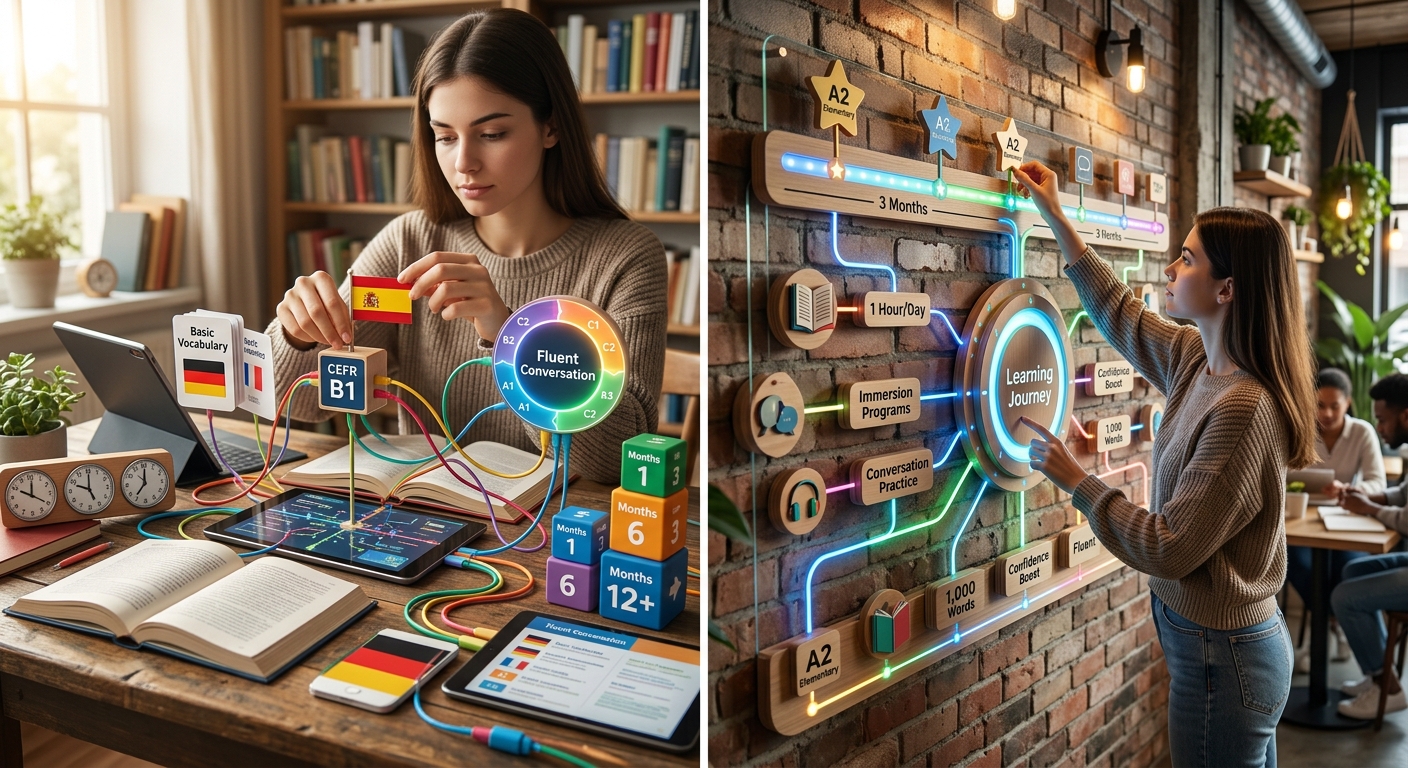
Reaching A1, the beginner survival level, typically takes 60 to 90 hours for an easier language and can be achieved within a month or two of consistent daily study. A2, elementary proficiency that allows basic everyday conversation, generally takes an additional 90 to 120 hours. B1, considered the threshold of conversational independence, often requires a cumulative 350 to 400 hours, meaning many learners reach basic conversational comfort within six months to a year of steady practice. B2, upper-intermediate proficiency where learners can discuss abstract topics and understand most native media, typically requires 500 to 600 cumulative hours. C1 and C2, advanced and near-native mastery, can require 700 to 1,000-plus hours depending on the language family, often taking committed learners two to four years to reach.
These numbers offer one of the clearest practical answers to how long does it take to learn a new language, because they map directly onto real communicative milestones rather than abstract classroom hour totals.
Implementation: Building an Effective Learning Plan
Knowing the numbers is only half the equation; implementation determines whether you actually hit them. A well-structured plan blends four pillars: input, output, review, and immersion. Input includes reading and listening practice that exposes you to natural language patterns. Output includes speaking and writing, which force active recall and reveal gaps in your knowledge. Review, often the most neglected pillar, uses spaced repetition systems to keep vocabulary and grammar from fading. Immersion, even in small doses, keeps motivation high and shows real-world application.
A practical weekly plan for someone serious about shortening how long does it take to learn a new language might include daily vocabulary review using flashcard apps, three to four sessions of guided grammar study, at least two conversation practice sessions with a tutor or exchange partner, and daily passive exposure through podcasts, music, or shows in the target language. Learners who follow a structured plan like this consistently often cut their timeline by 20 to 30 percent compared to unstructured, sporadic studying.
Comparing Different Learning Methods
Not all study methods are equally efficient, and comparing them helps clarify how long does it take to learn a new language under different approaches. Traditional classroom courses offer structure and accountability but often move at a pace dictated by the group rather than the individual, which can slow faster learners down. Self-study apps offer flexibility and gamified motivation but frequently lack meaningful speaking practice, which can create a gap between recognition and active production. Private tutoring, especially one-on-one online tutoring, tends to produce faster results because instruction is tailored to the learner’s pace and weaknesses, though it is often more expensive. Immersion programs, including study-abroad experiences, consistently produce the fastest results because they combine structured instruction with constant real-world exposure, though they are not accessible to everyone due to cost and logistics.
A blended approach, combining an app for vocabulary building, a tutor for speaking practice, and regular exposure to authentic media, tends to produce the best balance of speed, affordability, and retention for most independent learners trying to figure out how long does it take to learn a new language realistically within their own life circumstances.
Regional and Cultural Impact on Language Acquisition
Where you learn a language, and the cultural environment surrounding your study, meaningfully shapes your timeline. Learners in multilingual regions, where switching between languages is a daily norm, often develop language-learning skills faster because their brains are already accustomed to managing multiple linguistic systems. Communities with strong access to language exchange groups, cultural centers, and native-speaker populations offer built-in immersion opportunities that learners in more linguistically isolated regions have to seek out deliberately, often through online platforms.
Cultural attitudes toward language learning also matter. In regions where multilingualism is culturally normalized and actively encouraged, learners tend to feel less self-conscious about making mistakes, which in turn accelerates speaking practice and, by extension, shortens how long does it take to learn a new language in practical, conversational terms. Access to affordable in-person classes, community language programs, and cultural exchange events can vary significantly by region, and learners in areas with fewer resources often rely more heavily on digital tools to close that gap.
Success Stories and Real-World Case Studies
Real learner experiences add valuable texture to the statistics. Polyglot communities online are filled with documented case studies of learners reaching conversational fluency in a new language within three to six months using intensive immersion techniques, often by relocating temporarily or dedicating several hours daily to focused practice. Language exchange platforms have also produced countless success stories where consistent, moderate daily practice over twelve to eighteen months led learners from complete beginners to confident conversationalists capable of holding professional discussions.
One common thread across these success stories is that learners who tracked their progress against clear milestones, rather than vague goals like “becoming fluent,” reported feeling more motivated and less likely to quit. This reinforces a core theme throughout any honest discussion of how long does it take to learn a new language: specific, measurable goals consistently outperform broad, undefined ambitions.
Common Challenges Learners Face
Despite the encouraging data, most learners hit predictable obstacles. Plateaus are extremely common, particularly around the intermediate stage, where learners can understand a great deal but still struggle to express complex thoughts fluidly. This plateau often causes frustration and is one of the leading reasons people abandon their studies, mistakenly believing they have hit a ceiling rather than a temporary, well-documented phase of acquisition.
Inconsistent practice is another major obstacle. Life responsibilities, work, and motivation dips naturally interrupt study schedules, and without a system for maintaining minimum consistency, months of progress can quietly erode. Fear of making mistakes, especially in speaking practice, also slows many learners down, since avoiding conversation to escape embarrassment directly limits the output practice necessary for fluency. Finally, unrealistic expectations set by marketing claims promising fluency in thirty days create disappointment when real progress, while genuine, unfolds more gradually and unevenly than advertised.
Comparing Timelines Across Popular Target Languages
Spanish and French, both Category I languages, generally allow English speakers to reach conversational comfort within six to nine months of consistent part-time study, and professional proficiency within a year of dedicated effort. German, a Category II language, typically takes a few months longer due to its case system and compound word structures. Russian and Hindi, both Category III languages, often require twelve to eighteen months of consistent study to reach solid conversational ability due to unfamiliar scripts and more complex grammar. Mandarin, Japanese, Korean, and Arabic, the Category IV languages, generally require eighteen months to three years of consistent effort to reach comparable conversational milestones, primarily due to tonal systems, character-based writing, or unfamiliar phonetic and grammatical structures.
These comparisons make clear that how long does it take to learn a new language is inseparable from which language you choose, and setting expectations according to your target language’s difficulty category prevents unnecessary discouragement.
The Role of Technology in Shortening Learning Timelines
Modern language-learning technology has meaningfully compressed timelines compared to a generation ago. Spaced repetition apps optimize vocabulary retention far more efficiently than traditional rote memorization. Speech recognition tools allow learners to practice pronunciation without needing constant access to a native speaker. AI-powered conversation partners now offer on-demand speaking practice at any hour, removing one of the biggest historical bottlenecks, which was simply finding enough opportunities to talk. Video platforms and streaming services with target-language content, often with adjustable subtitle support, have also made authentic immersion accessible from home, further influencing how long does it take to learn a new language for today’s self-directed learners compared to previous decades.
Future Prospects and Evolving Approaches
Looking ahead, personalized learning powered by adaptive algorithms is likely to keep shortening average timelines, since programs increasingly adjust difficulty and review scheduling based on individual performance rather than a fixed curriculum. Virtual and augmented reality immersion tools are also emerging, potentially offering simulated real-world environments for practice without the cost of travel. As these tools mature, the gap between institutional, full-time training timelines and independent self-study timelines is expected to narrow further, making the question of how long does it take to learn a new language increasingly dependent on personal discipline rather than access to resources, which historically was the greater barrier.
Setting Your Own Realistic Timeline
Given everything above, the most useful way to answer how long does it take to learn a new language for yourself is to define your goal clearly, identify your target language’s difficulty category, estimate your available weekly study hours, and multiply accordingly using the proficiency-level benchmarks outlined earlier. A realistic, encouraging rule of thumb is that most motivated learners studying five to seven hours weekly can reach conversational comfort in an easier language within eight to twelve months, and in a harder language within eighteen months to two years. Adjust upward for less study time, and downward if you can incorporate immersion, tutoring, or travel into your routine.
Conclusion
There is no universal answer to how long does it take to learn a new language, but there is a reliable framework for estimating your own path. Your timeline depends on the language’s difficulty relative to your native tongue, your weekly study consistency, your access to immersion opportunities, and the clarity of your personal goals. Whether you are aiming for basic travel conversation or professional fluency, understanding these variables lets you set expectations that keep you motivated rather than discouraged. Progress in language learning is rarely linear, but with consistent effort and the right combination of methods, meaningful fluency is achievable well within a realistic, well-planned timeframe.
Frequently Asked Questions
Is it possible to become fluent in a language in just three months?
For easier, closely related languages, some highly immersed learners report reaching strong conversational fluency in three to six months, but true native-level fluency almost always takes significantly longer, often years of continued exposure and practice.
Which language is fastest for English speakers to learn?
Spanish, French, Italian, Portuguese, and Dutch are generally considered the fastest for native English speakers, largely due to shared vocabulary and simpler grammatical structures compared to more distant languages.
Does age really affect how long does it take to learn a new language?
Age plays a role, particularly in accent acquisition, but adults often learn grammar and vocabulary more efficiently than children due to stronger analytical skills, so age alone is not the dominant factor most people assume it to be.
How many hours a day should I study to learn a language quickly?
One to two hours of focused daily practice, combined with passive exposure through media, tends to produce strong, sustainable progress without leading to burnout, which is more effective long-term than sporadic, intense study sessions.
Can apps alone teach me a language, or do I need a tutor?
Apps are excellent for vocabulary and grammar foundations, but most learners need dedicated speaking practice with a tutor or conversation partner to develop true conversational fluency, since apps alone often underdevelop active speaking skills.
What is the hardest language for English speakers to learn?
Mandarin Chinese, Cantonese, Japanese, Korean, and Arabic are generally classified as the most challenging for native English speakers, primarily due to unfamiliar writing systems, tonal elements, or significantly different grammar structures.
Does immersion really make that much of a difference?
Yes, immersion is one of the most powerful accelerators in language learning, since constant real-world exposure forces active use of the language and reinforces vocabulary and grammar far more effectively than study alone.













Leave a Reply