


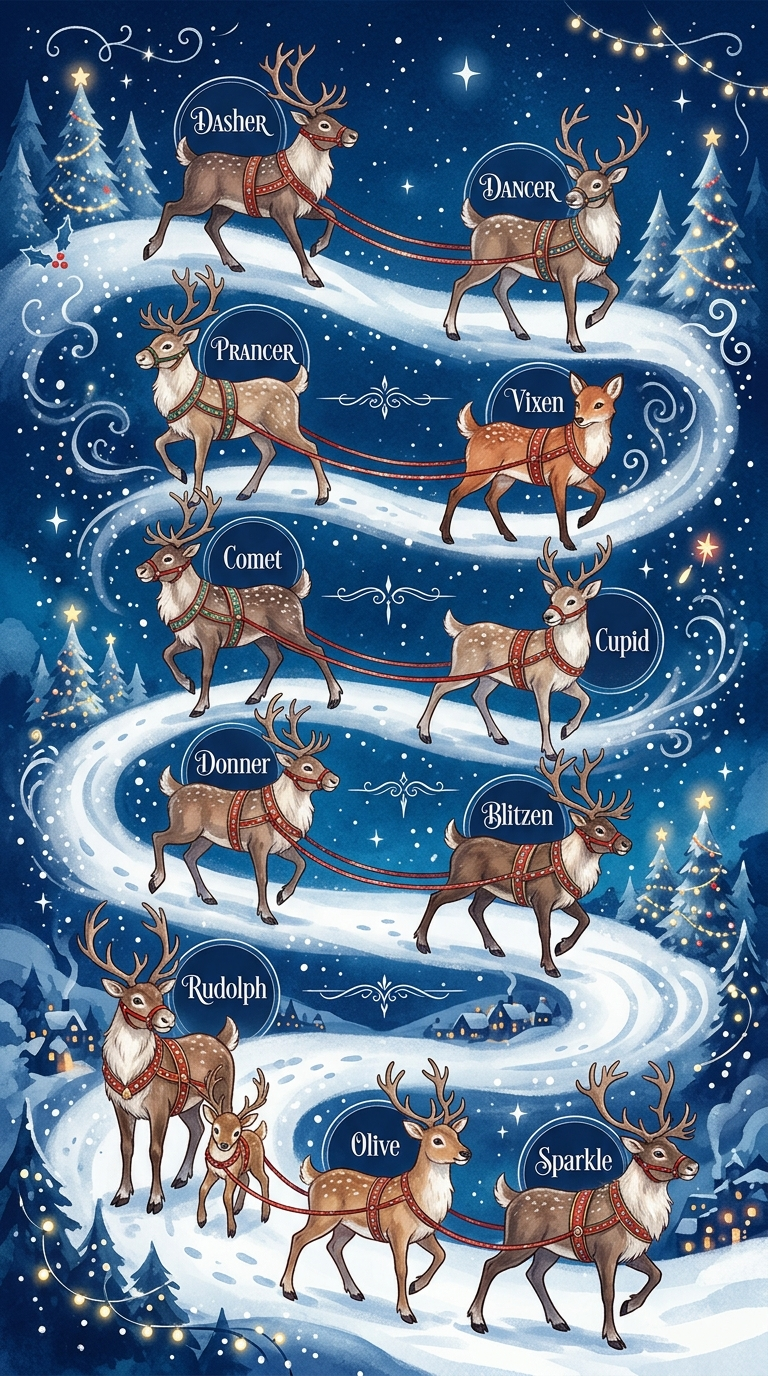
Every December, millions of people around the world type some version of the same question into their search bar: what is the name of the 12 reindeers in order It is one of the most searched holiday trivia questions of the season, right up there with “what time does Santa arrive” and “how many houses can Santa visit in one night.” Parents want to settle bedtime debates, teachers want quiz-ready answers for classroom activities, and trivia enthusiasts want bragging rights at the annual office party. Yet here is the twist that surprises almost everyone who searches for the names of the 12 reindeer in order: Santa Claus does not actually have twelve reindeer pulling his sleigh. He has nine.
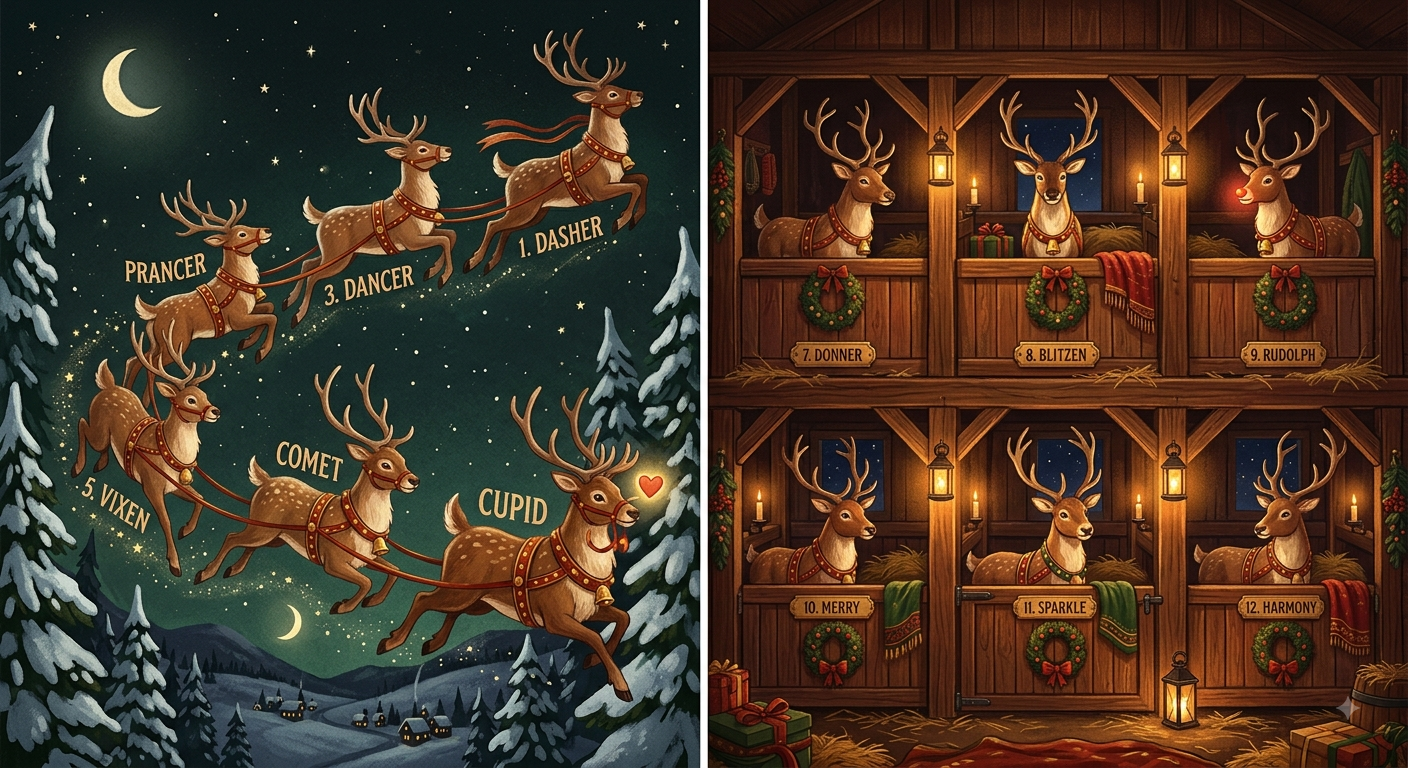
This article exists to give you the full, factually accurate, and genuinely entertaining story behind that mix-up, while also delivering exactly what most searchers are actually looking for — the complete, correctly ordered list of Santa’s reindeer, their origins, their personalities, and why the “12 reindeer” myth became so widespread in the first place. Whether you arrived here hoping to confirm a list of twelve names or simply wanted a definitive answer once and for all, you are about to get the most thorough breakdown available anywhere online.
Where the Legend of Santa’s Reindeer Actually Began
To understand why so many people search for the names of the 12 reindeer in order, it helps to go back to where the reindeer legend started. Santa Claus, as most of the Western world recognizes him today, is a relatively modern cultural construction built from older European folklore, Dutch Sinterklaas traditions, and a generous dose of nineteenth-century American literary imagination. The reindeer, specifically, trace their origin to a single poem.
In 1823, a poem titled “A Visit from St. Nicholas” was published anonymously in a New York newspaper. It later became widely known by its opening line, “‘Twas the Night Before Christmas.” This poem is the single most influential piece of literature in shaping how the world imagines Santa Claus, his sleigh, and the animals that pull it. Before this poem, Santa Claus figures in various cultures were not consistently associated with flying reindeer at all. The poem changed that permanently, and it is the original source for eight of the nine names people now associate with Santa’s reindeer team.
The author is widely credited as Clement Clarke Moore, though there has been long-standing scholarly debate over whether Henry Livingston Jr. actually wrote it. Regardless of authorship, the poem’s description of “eight tiny reindeer” pulling a sleigh through the night sky became the foundational text for the entire mythology. Once you understand this literary origin, the confusion around the number twelve starts to make a lot more sense, because nowhere in the original poem, nor in any of the major cultural additions that followed, does the number twelve ever appear in connection with reindeer.
The Real List: Santa’s Reindeer Names in Order
So if people are searching for the names of the 12 reindeer in order, what should they actually be looking for? The correct and complete list contains nine reindeer, and the order matters because it reflects both the original 1823 poem and the later addition that completed the modern team. Here is the full, accurate list in the order most commonly used in books, films, and holiday traditions.
The original eight reindeer, as introduced in “A Visit from St. Nicholas,” are Dasher, Dancer, Prancer, Vixen, Comet, Cupid, Donner, and Blitzen. These names appear in the poem in exactly this sequence, called out by Santa himself as he directs his sleigh upward into the night sky. Dasher leads the charge with his name evoking speed and momentum. Dancer follows, suggesting grace and lightness in flight. Prancer continues the movement-themed naming pattern, conjuring the image of a reindeer stepping high and proud. Vixen, interestingly, is the only name among the original eight with a slightly cheeky or clever connotation, since the word traditionally refers to a female fox known for cunning.
Comet and Cupid come next, bringing celestial and romantic imagery into the mix. Comet suggests streaking speed across the sky, much like the astronomical phenomenon it is named after, while Cupid nods to the Roman god of love, adding a touch of whimsy to the otherwise action-oriented lineup. The final two names from the original poem, Donner and Blitzen, are German in origin, translating roughly to “thunder” and “lightning.” This linguistic choice reflects the poem’s engagement with older Dutch and German Christmas traditions that influenced early American Santa Claus folklore.
Then comes the ninth reindeer, the one every single person recognizes even if they cannot name the other eight: Rudolph. Rudolph the Red-Nosed Reindeer was not part of the original 1823 poem at all. He was introduced over a century later, in 1939, as the star of a promotional booklet written by Robert L. May for the Montgomery Ward department store chain. Rudolph’s now-famous glowing red nose, his position at the very front of the sleigh team, and his underdog story of being mocked by the other reindeer before saving Christmas with his unique gift, cemented his place as the unofficial tenth member of Santa’s crew, even though in terms of naming history he is technically the ninth reindeer added to the canon.
So when someone asks for the names of the 12 reindeer in order, the accurate and complete answer is: Dasher, Dancer, Prancer, Vixen, Comet, Cupid, Donner, Blitzen, and Rudolph. Nine names, not twelve, but every bit as magical and memorable.
Why the “12 Reindeer” Search Term Became So Popular
Given that the actual number is nine, it is worth exploring why the search phrase “the name of the 12 reindeer in order” has become such a common query. There are a few reasonable explanations, and understanding them actually adds depth to the holiday folklore rather than detracting from it.
The most straightforward explanation is simple misremembering. Twelve is a number deeply associated with the Christmas season through the well-known carol “The Twelve Days of Christmas.” Because the number twelve is already anchored in people’s minds as a significant holiday figure, it is an easy and understandable mental substitution to assume Santa’s reindeer team also numbers twelve. The carol has nothing to do with reindeer directly, focusing instead on gifts given across the twelve days following Christmas Day, but the repeated exposure to “twelve” during the holiday season likely bleeds into how people recall other Christmas-related lists.
Another explanation involves generational retellings and children’s books. Over the decades, countless unofficial adaptations, coloring books, greeting cards, and regional retellings have added supplementary reindeer, alternate names, or entirely invented characters to pad out stories or create new merchandise opportunities. While none of these have become part of the accepted canon the way Rudolph did, their existence in scattered pockets of pop culture may have contributed to public uncertainty about the exact number.
There is also the simple psychological effect of round numbers. Twelve feels like a tidier, more “complete” number than nine, especially in a culture where dozens are a familiar unit of counting. When people are unsure of an exact figure, there is a natural tendency to round toward a number that feels more structurally satisfying, and twelve fits that bill far better than nine does.
Finally, search engine behavior itself may reinforce the confusion. Once enough people begin searching for “12 reindeer names,” content creators and marketers respond to that demand by producing content using that exact phrase, even when the underlying information corrects the number. This creates a feedback loop where the search term persists in popularity even as the content answering it clarifies the actual number, which is precisely the situation this article addresses.
The Personality and Symbolism Behind Each Reindeer Name
Understanding the meaning behind each name adds richness to the full list of Santa’s reindeer and helps explain why this cast of characters has endured in popular imagination for two centuries. Each name was chosen with a distinct personality or symbolic association in mind, whether by Clement Clarke Moore in the original poem or by Robert L. May when he introduced Rudolph over a hundred years later.
Dasher represents speed and eagerness, often depicted as the natural leader who sets the pace for the rest of the team. Dancer embodies elegance and lightness of movement, frequently illustrated in children’s books as graceful and light-footed even in flight. Prancer is typically shown as proud, energetic, and a little showy, matching the visual image of a reindeer stepping high with confident, exaggerated motion. Vixen, drawing from the word’s traditional meaning, is often portrayed as clever, quick-witted, and a touch mischievous compared to her more straightforward teammates.
Comet and Cupid introduce a shift in theme from motion to celestial and emotional symbolism. Comet is generally associated with brightness, speed, and dramatic flair, echoing the image of a comet streaking across a night sky. Cupid, borrowing from Roman mythology, is often depicted as the sweet, affectionate member of the group, sometimes portrayed in modern retellings as the reindeer most connected to spreading goodwill and warmth during the holiday season.
Donner and Blitzen carry the weight and power of their German-language roots. Donner, meaning thunder, and Blitzen, meaning lightning, are frequently illustrated as the strongest and most powerful members of the team, contributing raw energy to the sleigh’s flight, especially during storms or turbulent weather in various retellings.
Rudolph, of course, stands apart from the rest, not because his name carries a particularly deep etymological meaning, but because his entire narrative arc is built around individuality, resilience, and eventual acceptance. Unlike the original eight, who were introduced together as an already-established, confident team, Rudolph’s story begins with him being excluded and teased for his glowing red nose. His eventual triumph, guiding the sleigh through a foggy Christmas Eve when the other reindeer could not see the way, transformed him into the most emotionally resonant character in the entire mythology. This narrative depth is part of why Rudolph, despite being a relatively late addition, is now often mistakenly assumed to have always been part of the original lineup, and it may be part of why some people round the reindeer count up in their minds, searching for a number larger than nine without quite landing on the correct twelve-day carol association either.
The Regional and Cultural Impact of the Reindeer Legend
The story of Santa’s reindeer has not stayed confined to the United States, where the modern version originated. It has spread globally, adapting and blending with pre-existing regional Christmas traditions in fascinating ways, and understanding this regional impact helps explain why the reindeer legend feels so universally embedded in holiday culture today, even in places without native reindeer populations.
In parts of Northern Europe, particularly in Scandinavian countries and regions of Finland closely associated with Santa Claus folklore through the Lapland connection, reindeer already held deep cultural and economic significance long before the American poem popularized the flying sleigh team. Indigenous Sámi communities in the Arctic regions of Norway, Sweden, Finland, and Russia have herded reindeer for centuries as a central part of their livelihood, culture, and identity. When the American Santa Claus mythology, complete with his named reindeer team, merged with the pre-existing association between the far north and Christmas magic, it created a powerful cultural fusion that positioned Lapland as the “official” home of Santa Claus in much of the popular imagination.
In the United Kingdom and other Commonwealth nations, the reindeer names spread primarily through literature, later reinforced by American film and television exports throughout the twentieth century. British Christmas cards, school pageants, and holiday specials adopted the same nine names, with Rudolph often given even greater prominence than in some American retellings due to the massive popularity of the 1949 song “Rudolph the Red-Nosed Reindeer,” which became one of the best-selling holiday songs of all time and is largely responsible for cementing Rudolph’s place in the canon worldwide.
In non-English-speaking countries, translations of the reindeer names vary, sometimes preserving the English originals and sometimes adapting them to fit local language patterns and cultural resonance. This localization process mirrors the way many other Western Christmas traditions have been regionally adapted while maintaining a recognizable core structure, a pattern seen in how holiday marketing, retail promotions, and even social welfare-style community toy drives during the season borrow imagery from the same nine-reindeer mythology to create instantly recognizable emotional appeal.
The commercial impact of the reindeer legend is also worth noting. Retailers worldwide use the reindeer, particularly Rudolph, as central branding figures during the holiday shopping season, a tradition that fittingly traces back to Rudolph’s own origin as a promotional character created for a department store’s holiday marketing campaign. This commercial dimension has helped keep the names alive and searchable across generations, ensuring that questions like “what is the name of the 12 reindeer in order” remain a consistently popular query every holiday season, even though the search itself is built on a numerical misunderstanding.
Reindeer in Film, Television, and Modern Media
Beyond the original poem and the 1939 promotional booklet, Santa’s reindeer team has been reinforced and expanded upon through decades of film, television, and popular media, each contributing to how new generations learn and remember the names.
The 1964 stop-motion television special “Rudolph the Red-Nosed Reindeer,” produced by Rankin/Bass, remains one of the most influential adaptations in the entire mythology. It introduced beloved side characters, expanded Rudolph’s backstory, and became an annual broadcast tradition in the United States for decades, embedding the reindeer names even more firmly into mainstream holiday culture. This special, along with the original song, is arguably more responsible than the 1823 poem itself for making Rudolph a household name on par with, or even exceeding, recognition of the original eight.
Later films and television specials continued building on this foundation. Various animated features throughout the 1980s, 1990s, and 2000s have depicted the reindeer team with slightly different personality interpretations, occasionally introducing minor or joke characters that briefly appear alongside the core nine but never achieve lasting canonical status. This pattern of media occasionally toying with the reindeer roster, adding a temporary tenth or eleventh character for comedic or narrative purposes within a single film, may also contribute to lingering public uncertainty about the “official” total number, further feeding searches for lists longer than the accurate nine.
Video games, mobile apps, and interactive Christmas websites aimed at children have also played a role in recent years, often including quizzes or matching games that ask players to name Santa’s reindeer in order, reinforcing the correct nine-name sequence for younger audiences while occasionally introducing playful, non-canonical additions purely for entertainment value.
Real Reindeer Versus the Reindeer of Legend
It is worth pausing to distinguish between the mythological reindeer with names like Dasher and Rudolph and actual, biological reindeer, since blending fact and fiction is part of what makes this topic so enduringly interesting to explore. Reindeer, known as caribou in North America, are a real species of deer native to Arctic and subarctic regions, including northern Europe, Siberia, and North America. They are uniquely adapted to cold climates, with specialized hooves for traversing snow and ice, thick insulating fur, and an ability to survive on lichen and other sparse vegetation during long winters.
One detail that adds an extra layer of charm to the Santa Claus mythology is the biological fact that both male and female reindeer can grow antlers, unlike most other deer species where only males typically do. Male reindeer, however, generally shed their antlers in early winter, around late November or December, while female reindeer retain their antlers longer, often through the winter months and into the spring. This biological detail has led to a popular piece of holiday trivia suggesting that since Santa’s reindeer are depicted with antlers throughout their Christmas Eve journey, they may all actually be female, or at least that the team includes primarily female reindeer, since males would typically have already shed their antlers by the time Christmas arrives. While this remains a fun piece of speculative trivia rather than an official detail confirmed anywhere in the original texts, it is a frequently cited fact that adds an interesting scientific layer to an otherwise purely fictional legend.
Understanding this distinction between the folklore version of the reindeer and their real biological counterparts also helps explain why the reindeer legend resonates so strongly across cultures with genuine, longstanding relationships with reindeer as animals, rather than feeling like a purely fictional import.
Comparing the Reindeer Legend to Other Holiday Traditions
Santa’s reindeer team is far from the only recurring numbered or named group in global holiday traditions, and comparing it to similar traditions helps illustrate why numerical confusion like the “12 reindeer” mix-up happens so easily. The Twelve Days of Christmas carol, as mentioned earlier, is one obvious point of comparison, listing twelve distinct gifts across twelve days without any reference to reindeer at all, yet the shared association with the word “twelve” during the same holiday season creates natural crossover confusion in casual conversation and search behavior.
Similarly, various cultures have their own numbered or named groups of magical helpers, gift-bringers, or seasonal figures. In some European traditions, Saint Nicholas is accompanied by companions with their own distinct names and roles, separate from any reindeer mythology entirely. In other regions, entirely different animals or magical creatures fulfill the role that reindeer play in the American and increasingly global Santa Claus narrative. These parallel traditions demonstrate that named, ordered lists of magical companions are a common storytelling device across many cultures, which may partly explain why audiences intuitively expect Santa’s reindeer count to be a larger, rounder number like twelve rather than the comparatively modest nine.
This comparison also highlights something important about how folklore evolves over time. Just as the original eight reindeer eventually grew to nine with Rudolph’s addition in 1939, it is entirely possible that public imagination continues to mentally “round up” the number in the decades since, especially given how frequently the reindeer appear in media alongside other numerically significant holiday traditions.
Common Challenges in Getting the List Right
Despite how iconic Santa’s reindeer are, there are a few recurring reasons people struggle to recall the complete and correctly ordered list, beyond simply confusing the total count with twelve.
One common challenge is the spelling and pronunciation of Donner and Blitzen. Because these names are German in origin, they are sometimes mistakenly Anglicized in casual retellings, with “Donner” occasionally misremembered as “Donder” (an actual historical variant that appeared in some early printings of the poem) and “Blitzen” sometimes shortened or altered. This linguistic inconsistency across different printings and adaptations over the past two centuries has contributed to minor variations in how the list is remembered and repeated.
Another challenge is the tendency to forget Cupid and Vixen specifically, likely because their names carry associations, romance and cunning, that feel slightly out of step with the otherwise speed and weather-themed naming pattern of the rest of the group. Names like Dasher, Dancer, Comet, Donner, and Blitzen all evoke motion or natural power, making Cupid and Vixen the two names most likely to be misremembered or left out entirely when someone is reciting the list from memory.
Finally, Rudolph’s relatively late addition to the canon, arriving over a century after the original eight, means that some older or more literary-minded retellings of the Santa Claus story omit him entirely, sticking strictly to the 1823 poem’s original eight names. This creates yet another layer of inconsistency, where some sources present eight names, others present nine, and popular imagination rounds upward toward twelve, making the full and accurate list feel more elusive than it actually is.
The Future of the Reindeer Legend
Looking ahead, it seems unlikely that Santa’s reindeer team will expand to an official twelve anytime soon, given how deeply embedded the current nine names are across two centuries of literature, film, music, and commercial branding. However, the enduring popularity of search queries asking for the names of the 12 reindeer in order suggests that public fascination with expanding, reinterpreting, or simply misremembering the details of this beloved holiday tradition will likely continue for generations to come.
Future adaptations in film, streaming media, and interactive digital experiences may continue to playfully introduce temporary or joke reindeer characters, further blending fact and fiction in the public consciousness. At the same time, educational content, family-friendly holiday resources, and articles like this one play an important role in preserving the accurate historical record, ensuring that even as playful reinterpretations continue, the true origin story, nine reindeer, not twelve, remains accessible and clearly explained for anyone curious enough to look it up.
Ultimately, the enduring appeal of Santa’s reindeer, whether people remember eight, nine, or mistakenly twelve, speaks to how powerfully this piece of nineteenth-century American poetry has shaped global holiday culture. Few literary creations have achieved this level of lasting, cross-cultural resonance, transforming a simple set of animal names into one of the most recognizable and beloved aspects of Christmas tradition worldwide.
Frequently Asked Questions
What is the name of the 12 reindeer in order, and is that number actually correct?
The commonly searched number twelve is not accurate. Santa Claus has nine reindeer, not twelve. The correct and complete list, in order, is Dasher, Dancer, Prancer, Vixen, Comet, Cupid, Donner, Blitzen, and Rudolph.
Why do so many people believe there are 12 reindeer instead of nine?
The confusion likely stems from the popularity of the “Twelve Days of Christmas” carol, which has nothing to do with reindeer but strongly associates the number twelve with the Christmas season, leading many people to misremember or round up the reindeer count.
Who created the original list of Santa’s reindeer names?
The original eight reindeer names, Dasher, Dancer, Prancer, Vixen, Comet, Cupid, Donner, and Blitzen, come from the 1823 poem “A Visit from St. Nicholas,” widely attributed to Clement Clarke Moore, though authorship has been debated.
When was Rudolph added to the list of Santa’s reindeer?
Rudolph was introduced in 1939, more than a century after the original eight, as the main character of a promotional booklet written by Robert L. May for the Montgomery Ward department store.
Is Rudolph officially considered part of Santa’s main reindeer team?
Yes. While Rudolph was a later addition, his massive popularity, driven by the 1949 hit song and the 1964 television special, has made him a permanent and universally recognized member of the reindeer team, typically listed ninth and positioned at the front of the sleigh.
Are Santa’s reindeer based on real animals?
Yes, reindeer are a real species found in Arctic and subarctic regions, also known as caribou in North America. However, the specific named characters like Dasher and Rudolph are fictional creations rather than real, individual animals.
Do any adaptations actually include 12 reindeer instead of nine?
While the official, widely recognized canon includes only nine names, some minor or unofficial retellings, cartoons, and merchandise have occasionally introduced extra reindeer characters for entertainment purposes. None of these have replaced or officially expanded the accepted nine-name list.













Leave a Reply